
Continuous cardiovascular prevention

One system. From risk detection to lasting change.

A continuous cardiovascular prevention platform connecting risk assessment, diagnostics, clinical guidance, connected devices, behaviour change and monitoring, so every detected risk can lead to sustained action and measurable progress.

See how it works

Already invited?

  • Cardiovascular health first

    Continuous prevention by design

  • Designed with specialists

    Guideline-based clinical logic

Member dashboard

Today · prevention plan

Devices connected

10-yr CV risk

12.4%

↓ 3.1

Moderate · reassessed 12 Sep

Home BP · 7-day

128/81

14 of 14 measurements taken

Adherence signal

84%

Pill box and refill, last 30 days

Today's actions

2 / 4 done

  • Morning BP measurement
  • Amlodipine 5 mg
  • 30-minute walk, 2 of 5 this week
  • Book lipid panel, due in 9 days

Zoe: your evening readings are 6 mmHg lower this week. Keep the same routine before your next review.

Illustrative product interface

02 · One ecosystem

One prevention ecosystem. Built around the person.

The platform connects employers, insurers, healthcare providers and public-health systems around one continuous prevention journey, while giving every person one simple place to understand and manage their health.

For businesses and insurers

Identify risk earlier, improve follow-through, and help members take the actions that reduce preventable health risks.

See the organisation dashboard

For governments

Turn population screening into continuous risk management, follow-up and measurable preventive action.

See the population dashboard

For individuals

Know your risks, understand what to do next, and get practical support to actually do it.

See how it works

03 · The reality

Cardiovascular disease is the world's biggest killer. Much of it is preventable.

No. 1 source 1

Cardiovascular disease is the leading cause of death worldwide.

19.8M source 1

People died from cardiovascular disease in 2022, approximately 32% of all deaths globally.

80% source 2

The World Heart Federation states that 80% of cardiovascular disease deaths are preventable.

77% source 3

77% of adults with hypertension do not have it under control.

The problem is not that we know nothing about cardiovascular risk. The opportunity is to make prevention happen consistently, before risk becomes disease.

04 · How it works

One system connects risk detection to sustained action and measurable progress.

The platform combines health history, personalised diagnostics, clinical guidance, connected data and behavioural support in one continuous cardiovascular prevention journey.

Step 01 · Understand

01 / 06

Build a detailed health profile from anamnesis, medical history, previous results, lifestyle and available health data.

  • Anamnesis
  • Medical records
  • Lifestyle
  • Family history
UNDERSTANDstep 01 of 06

05 · The action gap

The critical gap in prevention is sustained execution.

Once cardiovascular risk is identified, the next challenge is sustained adherence across medication, measurements, diagnostics, physical activity, nutrition and follow-up.

27–40% source 4

Estimated non-adherence to antihypertensive medication in a large meta-analysis.

~50% source 4

Medication discontinuation approaches 50% within two years after the first antihypertensive prescription.

31% source 5

Nearly one-third of adults worldwide, around 1.8 billion people, do not achieve recommended levels of physical activity.

2×+ source 6

Average global salt intake is about 11 g a day, more than twice the WHO recommendation of less than 5 g. Excess sodium was associated with an estimated 1.7 million deaths in 2023.

One system should connect risk detection, action, adherence and measurable change.

See it in the dashboards

06 · Dashboards and continuous monitoring

See cardiovascular risk, actions and progress in one view.

Dashboards are a primary product surface, not a secondary reporting feature. They make the relationship between risk, recommended actions, actual behaviour and health change visible over time.

Member view · 90-day cardiovascular record

Illustrative data

Home blood pressure · 90 days

Systolic average per week, mmHg

  • Systolic
  • Diastolic
  • Target 130
16014012010080TARGET 130W1W4W7W10W13

Measurement consistency

91% of scheduled measurements completed

Key markers

LDL-C
3.4 → 2.6 mmol/L
HbA1c
5.8%
Weight
−3.1 kg / 90 d
Sleep
6 h 52 m

Medication adherence

84%

Pill-box signal, 30 d

Physical activity

168 min / week

Goal 200 min · trending up 4 weeks

Next in the plan

  • 09 dLipid panel
  • 21 dCardiology teleconsult
  • 30 dRisk reassessment

Open clinical flag

Three evening readings above 150 mmHg in 10 days, escalated to the care team for review.

07 · Cardiovascular focus

Cardiovascular risk reflects the cumulative impact of multiple health factors.

Cardiovascular disease rarely develops in isolation. Blood pressure, cholesterol, glucose, weight, physical activity, smoking, sleep, medication adherence and other factors interact over years.

These signals are brought together to manage cardiovascular risk in context and support action on the factors driving that risk.

Cardiovascular prevention is the first clinical focus, not the boundary of the platform.

CV RISK

in context

  • Blood pressure
  • LDL / cholesterol
  • Glucose
  • Weight
  • Activity
  • Sleep
  • Smoking
  • Medication
  • Family history

08 · Meet Zoe

Meet Zoe. Your AI health coach between medical visits.

Medical recommendations are useful only when people understand and act on them. Zoe turns complex health information into practical everyday guidance: understanding a result, knowing what matters today, preparing for a consultation, and following through on nutrition, activity, sleep, measurements and follow-up.

Zoe operates within the platform's clinical knowledge layer, established guidelines, peer-reviewed evidence and behavioural-science principles. The medical logic is designed with leading specialists and continuously monitored and developed with them.

AI does not replace medical care. It makes prevention easier to understand and easier to follow.

Zoe

Connected to your health record

  1. My LDL came back at 3.4. Should I be worried?
  2. On its own 3.4 mmol/L is moderately elevated. With your blood pressure and family history it moves your 10-year risk into the moderate band, which is why it is a priority in your plan.
  3. From your record

    LDL-C
    3.4 mmol/L
    Home BP · 7-day
    128/81
    Family history
    Early CVD, father
  4. Two things for the next 30 days: keep evening measurements consistent, and shift one meal a day toward the plan we set. Your cardiology teleconsult is in three weeks, so I will prepare a summary.

09 · Science

Funding the science of better prevention.

Preventive medicine still has major unanswered questions, especially around adherence, sustained behaviour change, longitudinal risk, and how digital interventions should work in real life.

The Science fund identifies high-value research questions, brings together research teams, funds studies, and orchestrates collaboration around the areas where better evidence can improve prevention.

The purpose is simple: generate better evidence for how prevention actually works outside the clinic.

Priority research areas

08

  1. 01Cardiovascular prevention
  2. 02Medication and measurement adherence
  3. 03Behaviour change and habit formation
  4. 04Just-in-time adaptive interventions
  5. 05Wearables and connected medical devices
  6. 06Longitudinal risk signals
  7. 07Preventive-care engagement
  8. 08Real-world evidence

10 · Insights

The science worth knowing. Without the noise.

Continuous filtering of preventive-health research, guidelines and news: what the evidence says, how strong it is, and whether it changes anything today.

  • A man filling a weekly pill box at home

    Behaviour changePeer-reviewed review

    Almost half of people starting a blood-pressure medicine stop within two years

    Discontinuation approaches 50% two years after a first antihypertensive prescription, and non-adherence estimates range from 27 to 40%.

    European Journal of Preventive Cardiology, 2025

    Original source

  • A woman asleep wearing a tracker, with a sleep-data screen beside her

    Physical activityWHO global surveillance

    Nearly a third of adults do not move enough

    Around 1.8 billion adults do not reach recommended levels of physical activity. Activity is one of the few factors that moves blood pressure, weight, glucose and sleep at the same time.

    WHO, updated periodically

    Original source
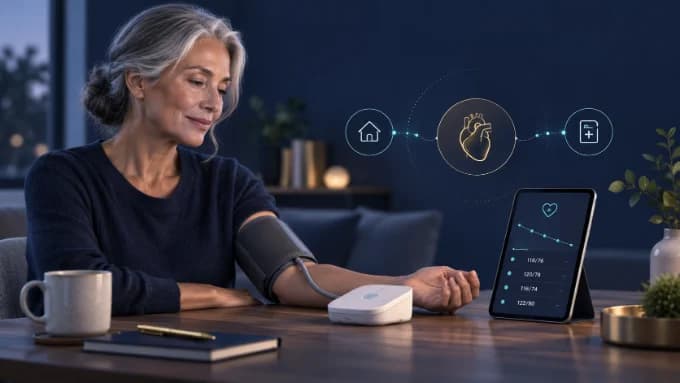
  • A woman taking her own blood pressure at home

    NutritionWHO fact sheet

    Salt intake is running at more than double the recommendation

    Global mean intake is about 11 g a day against a WHO recommendation of less than 5 g, and an estimated 1.7 million deaths in 2023 were associated with excess sodium.

    WHO, updated periodically

    Original source

No miracle claims. No longevity hype. The original evidence is linked whenever it is available.

11 · Privacy and trust

Your health data belongs to you.

Health information is deeply personal. The platform is designed around secure handling of medical information, controlled access and clear consent, so you understand when information is shared, why, and who can access it.

Noreon will never build its business around selling your health information.

  • Controlled access

    Role-based access to clinical data

  • Secure handling

    Encryption in transit and at rest

  • Clear consent

    Explicit, revocable sharing choices

  • Data portability

    You keep your own record

Move from risk detection to lasting change.

For organisations

Build a preventive-health programme that goes beyond screening and helps members act on their risks every day.

For members

Invited through your employer, insurer, healthcare provider or public programme? Build your health profile, follow your plan and see your progress over time.

One system. From risk detection to lasting change.

Noreon's medical logic and care pathways are designed with leading specialists, and continuously monitored and developed with them.